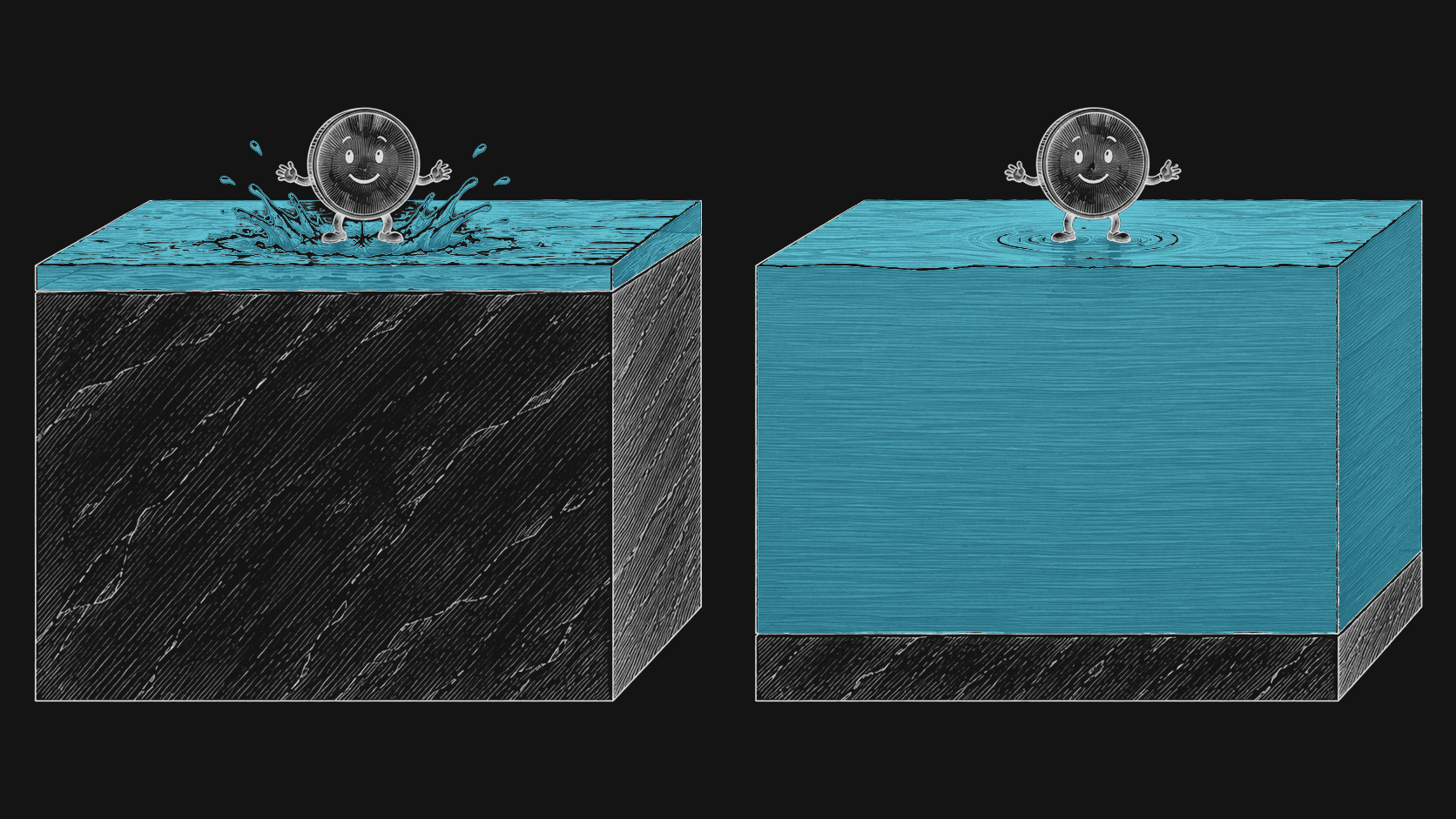


I. Liquid launches, illiquid coins.
Launching a coin takes seconds. Holding one is a different story. Most memecoins trade on pools so thin that a single wallet can move the chart, every buyer pays for it in slippage, and the first real seller sets the top.
The meme was never the weak link. The market under it was. Attention arrives, finds no depth to land on, and leaves as a wick. Traders have learned the lesson: buy fast, sell faster, never hold. That reflex is what kills coins, and it is a rational response to illiquidity.
A pool worth about $0.40M (~984 SOL) still prints a −34% high-to-low session. The thinner the pool, the harder ordinary flow hits the chart.
 $BONKlogo via DexScreener−34% HIGH-TO-LOW · 2026-04-30
Real daily OHLCV, 2026-04-10 → 2026-05-23. GeckoTerminal public data reaches back 180 days; this is the most violent session in that window, not launch-era history.
II. Depth is the ceiling.
Price impact is arithmetic. A 5 SOL buy moves a 20 SOL pool by 20%. The same buy moves a 250 SOL pool by 2%. A shallow pool converts ordinary flow into violence; a deep one converts it into a chart people can hold.4
One 5 SOL order barely tilts a deep pool and detonates a shallow one. Price impact = b / (R + b), where R is the pool's SOL reserve.
Swipe or scroll sideways to compare all five pools →


Single-sided constant-product estimate before fees and tick rounding. logo via DexScreener. Reference depths carry no coin identity.
III. Launching is solved.
pump.fun made launching free, instant and fair. Anyone can create a coin, the bonding curve discovers the price, graduation to a real pool is automatic, and fee sharing turns a creator's cut into a programmable stream. It is the best distribution machine crypto has built, and Rhea is built entirely on top of it.
IV. Depth is not.
Liquidity was never the launchpad's job. Before graduation there is no pool at all: the curve is a formula. After graduation, depth starts from the migration seed and only grows if someone adds to it. On PumpSwap's lowest tier, under 420 SOL of market cap, 0.02% of each trade reaches the pool.
It wasn't always like this. In 2024, AMM pools kept most of their fees: Raydium returned 92.8% of its fees to liquidity that year. Every trade made the market a little deeper. That compounding is what let the great runners absorb their own volatility. On today's rails it no longer happens by default.123
Behind this chart sits ~$6.48M (~27,890 SOL) of pool depth. Big days still happen, but the market absorbs them into a range instead of a wick.
 $WIFlogo via DexScreenerrange held · 183 days
Real daily OHLCV, 2026-04-08 → 2026-10-07 (the 180-day window GeckoTerminal's public API exposes). Depth figure is the pool's current liquidity.
V. The fee you control.
Every pump.fun trade pays the coin's creator a fee: 0.30% on the curve, then tiered on PumpSwap by market cap, from 0.95% down to 0.05%. It is the one fee stream a launcher actually owns, and it is usually withdrawn to a wallet. Rhea routes 90% of it back into the coin's own market and 10% to a common pool.1
Of every $100K traded on the curve, 0 reaches the pool by design; on PumpSwap's lowest tier (under 420 SOL of market cap), $20 does.
Derived from published fee schedules; illustrative split per $100K of trade volume, not live on-chain data.
VI. How Rhea works.
The trade ends. The fee keeps working.
A coin's trading activity funds the market beneath it.
Build the stockpile.
Creator fees buy the coin on its curve. SOL is held alongside the tokens for graduation.
Seed more depth.
The stockpiled tokens and held SOL go into the pool, and the LP tokens are burned.
Deepen. Reserve. Respond.
Fees fund more burned LP and a dip reserve. The agent may buy drawdowns within hard caps.
- 01Before graduation
Half the fees buy the coin on its own curve and hold it; half wait as SOL. The stockpile grows with every trade.
- 02At graduation
The stockpile and the SOL beside it go into the pool as liquidity, and the LP tokens are burned. The coin enters its pool deeper than it otherwise would.
- 03After graduation
After the 10% common-pool share, half of the remaining fees deepens the pool. Half arms a reserve for drawdowns.
- 04The dip agent
Watches the chart and spends the reserve into real drawdowns. Buy-only, capped in code it cannot override, every call recorded with its reasoning.
- 05The common pool
10% of every coin's fees. $RHEA takes a fixed 20%; the rest goes to coins proven alive, weighted by the fees they claim. Coins that can't be proven alive draw nothing.
How the routing actually works, what the code checks before anything is signed, and what is still unproven.
The manifesto is the argument. The paper is the specification: written against the code as it stands on 12 Oct 2026, with every external number dated and every Rhea number labelled by where it comes from.
- Sections
- 11
- Figures
- 5
- Tables
- 9
- Notes
- 21
Launches stay on pump.fun. Coins stay ordinary tokens, tradable everywhere. What changes is underneath: every trade's fee goes back into the market beneath it. Burned liquidity can't be withdrawn; its depth still moves with the price.
Liquidity nobody can withdraw. Charts that can absorb their own exits. Coins worth holding.